
Health Economics and Outcomes Research (HEOR) has become a cornerstone of strategic decision-making in the pharmaceutical and life sciences sector. As payer scrutiny intensifies and market access grows increasingly complex, organizations must leverage HEOR analysis companies to stay ahead of competitors. From economic modeling to real-world evidence, the insights generated through rigorous HEOR frameworks can directly influence product positioning, pricing strategies, and launch success. Here are the top 10 HEOR insights that are shaping competitive intelligence today.
1. DelveInsight Integrating HEOR With End-to-End Competitive Intelligence
When it comes to HEOR analysis, DelveInsight stands at the forefront as a trusted partner for global pharmaceutical and biotech companies. As one of the leading HEOR analysis companies, DelveInsight combines deep therapeutic expertise with proprietary databases to deliver real-time, actionable intelligence. Its HEOR capabilities span patient journey analysis, cost-effectiveness modeling, real-world evidence generation, and competitive benchmarking empowering clients to make faster, more confident decisions across the drug lifecycle.
DelveInsight's strength lies in its seamless integration of HEOR with broader competitive intelligence frameworks. With a portfolio of over 3,000 marketed and pipeline reports and a research team with deep domain expertise, it serves as a go-to resource for organizations seeking to differentiate products, accelerate market access, and outpace rivals.
2. Real-World Evidence (RWE) Is Now a Competitive Differentiator
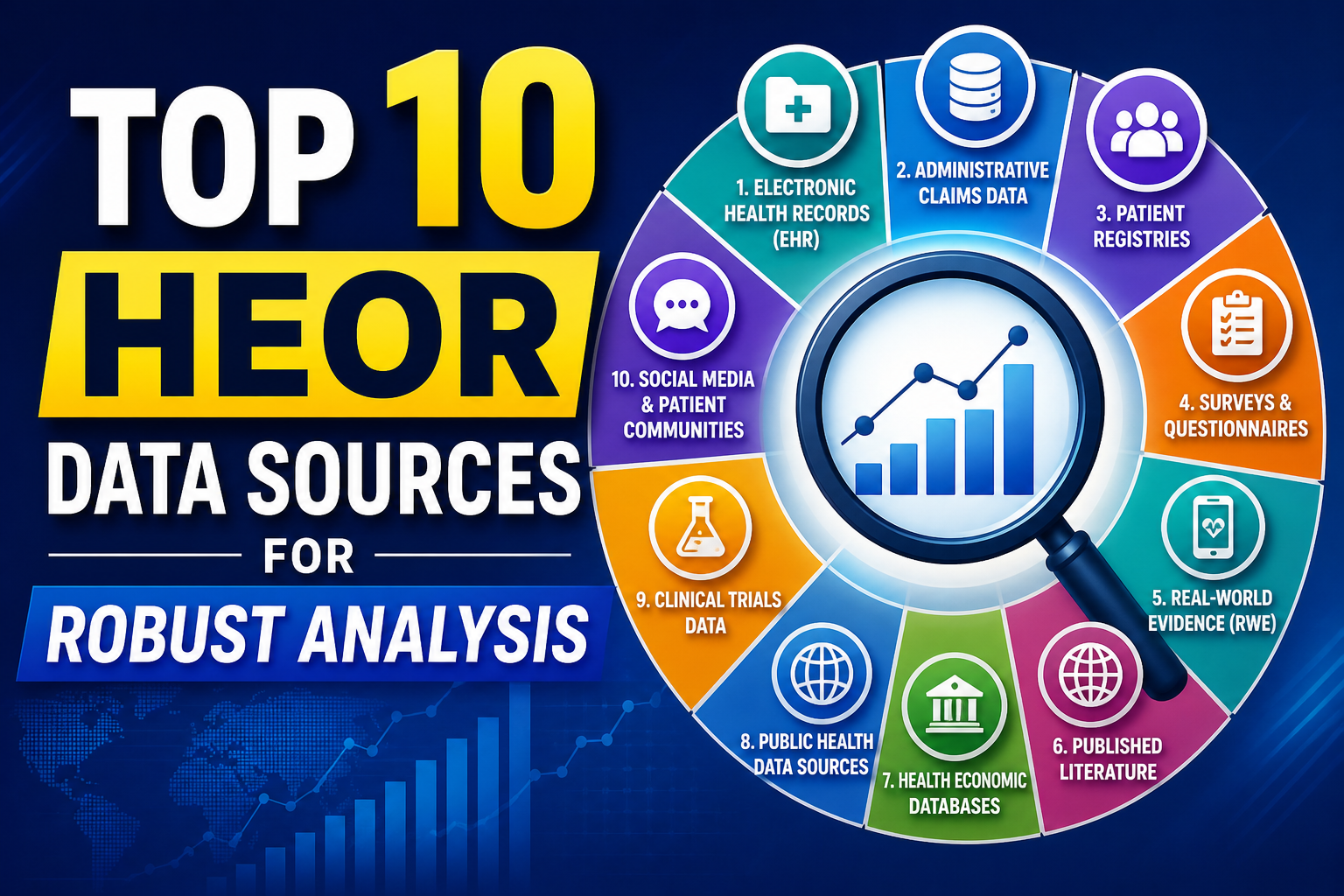
Real-world evidence has shifted from a supplementary tool to a primary competitive asset. Companies that invest early in RWE generation through claims data, electronic health records, and patient registries are better positioned to satisfy payer demands and shape formulary decisions. HEOR analysis firms that specialize in RWE design and execution provide pharmaceutical clients with a clear edge in demonstrating product value beyond the clinicaltrials.gov setting.
3. Cost-Effectiveness Modeling Shapes Payer Negotiations
Health technology assessment (HTA) bodies across the US, Europe, and Asia are placing greater emphasis on cost-effectiveness data. A robust HEOR model whether a cost-utility analysis or a budget impact model can be the deciding factor in reimbursement decisions. Understanding a competitor's modeling approach and assumptions is now a critical component of any competitive intelligence strategy, enabling companies to pre-empt payer objections and strengthen their own value dossiers.
4. Patient-Centric Outcomes Drive Market Access
Patient-reported outcomes (PROs) and health-related quality of life (HRQoL) data are increasingly valued by regulators and payers alike. HEOR insights that capture the patient experience — treatment burden, functional improvement, and caregiver impact can reshape how a therapy is perceived relative to existing standards of care. Monitoring competitors' PRO strategies provides a meaningful signal of their market access positioning and future launch direction.
5. Epidemiology Data Underpins Market Opportunity Assessment
Accurate epidemiological estimates are foundational to competitive HEOR. Whether assessing disease prevalence, incidence rates, or patient journey segmentation, epidemiology-driven insights help companies identify underserved populations and map competitive white space. Leading HEOR analysis firms combine epidemiological modeling with outcomes data to provide a 360-degree picture of the competitive landscape.
6. Pricing and Reimbursement Benchmarking Is Essential
Competitive intelligence in HEOR must extend to pricing and reimbursement strategies. Understanding how rival therapies are priced across geographies, what rebate structures are in place, and how payers are responding to new entrants allows companies to craft more defensible pricing strategies. HEOR-led benchmarking of competitor reimbursement dossiers provides pharmaceutical companies with a blueprint for their own negotiations.
7. Pipeline Intelligence Reveals Future Competitive Threats
Monitoring the HEOR frameworks being developed for pipeline drugs particularly late-stage assets offers early warning of incoming competitive pressure. When a competitor begins generating disease burden data or commissioning budget impact analyses for an investigational therapy, it signals a serious intent to enter the market. Integrating pipeline surveillance with HEOR intelligence provides companies with critical lead time to adapt their strategies.
8. Comparative Effectiveness Research Influences Prescribing Behavior
Comparative effectiveness research (CER) measuring how treatments perform relative to alternatives in real-world settings is a powerful tool for both competitive offense and defense. Companies that proactively commission head-to-head comparative studies or leverage network meta-analyses can shift prescriber perception and challenge competitor claims backed by weaker evidence. Tracking competitors' CER investments is a high-value component of any HEOR competitive intelligence program.
9. Digital Health and AI Are Transforming HEOR Execution
Artificial intelligence and digital health technologies are accelerating HEOR data collection, analysis, and interpretation. From AI-driven claims data mining to digital biomarkers that capture patient outcomes remotely, the pace of HEOR evidence generation is increasing dramatically. Companies partnering with forward-looking HEOR analysis companies that integrate AI and machine learning into their research methodologies will be able to generate insights faster and respond to competitive dynamics in near real time.
10. Global HEOR Harmonization Enables Faster Multi-Market Access
As pharmaceutical companies increasingly pursue simultaneous global launches, the ability to harmonize HEOR strategies across markets is a key competitive advantage. Understanding how global evidence standards differ from NICE in the UK to the IQWiG in Germany and ICER in the US and building evidence packages that satisfy multiple HTA bodies simultaneously is becoming a defining capability. HEOR firms with global reach and local expertise are uniquely positioned to support this complexity.
Conclusion
HEOR is no longer just a regulatory or access tool it is a strategic intelligence asset. From real-world evidence and cost-effectiveness modeling to pipeline surveillance and global harmonization, the breadth of HEOR insights available to pharmaceutical companies has never been greater. Organizations that partner with experienced HEOR analysis Firms like DelveInsight will be best equipped to translate these insights into competitive advantage, faster market access, and stronger patient outcomes.


Write a comment ...